Search This Blog

My Vertical Garden Wall

My Vertical Garden Wall

TRASLATION LANGUAGE (CLICK HERE)

Showing posts with label Pilea. Show all posts

Tuesday, April 28, 2020

Pilea spruceana ‘Norfolk’ - Angel Wings


This one has similar appearance of another pilea (Pilea involucrata  - Friendship Plant) but of a different coloration.

There is another one appears to be like Coleus looking with big foliage formation with furry leaf surface. But then, that particular one is also known as (Moon Valley Friendship Plant) which is also Pilea involucrata.

This particular one looks similar like episcia foliage colors with creeping charlie similarities. This one is very succulent looking and therefore must be very caution with over watering as it had died on me rotting.


This one is a larger version of compact foliage formation where the leaves are oval puckered leaves are bronze red with notes of grey, brown and black a version with much brilliant tones.

I believe this one is known as
Pilea spruceana ‘Norfolk’ is sometimes called Angel Wings or Silver Tree.

This is a slow growing plant and may prefer the brighter side of shaded area. Also it is a magnet for mealybugs. Once I had long but lost the battle with this pest followed by scale insects which was farmed by ants - the culprit.

Plant Care:

Bright shade with controlled watering - too much rots the plant from the root base.
Medium should be fast draining and moist - keep the medium dry before the next watering.
Also do check the foliage underside time to time for pest infection such as mealybugs or white flies.


Pilea involucrata - Friendship Plant


I have been searching for the ID and found it may be mislabeled as
Pilea involucrata  - Friendship Plant.

There is another similar looking one appears to be like Coleus looking with big foliage formation with furry leaf surface. But then, that particular one is also known as (Moon Valley Friendship Plant) which is also Pilea involucrata.


This one has smaller compact foliage formation where the leaves are in lighter notes of grey, brown and black coloration with trailing behavior.

This particular one looks similar like episcia foliage colors with creeping charlie similarities. This one is very succulent looking and therefore must be very caution with over watering as it had died on me rotting.


Adding to another mystery - there is now two different types.
The other has compact foliage formation where the leaves are oval puckered leaves are bronze red with notes, a version with much darker tones.

This is a slow growing plant and may prefer the brighter side of shaded area. Also it is a magnet for mealybugs. Once I had long but lost the battle with this pest followed by scale insects which was farmed by ants - the culprit.

I'm pretty sure there are many more variants and hybrids which may prove challenging and exciting to collect and cultivate.

Plant Care:

Bright shade with controlled watering - too much rots the plant from the root base.
Medium should be fast draining and moist - keep the medium dry before the next watering.
Also do check the foliage underside time to time for pest infection such as mealybugs or white flies.


Monday, April 27, 2020

Pilea microphylla - Rockweed


Pilea microphylla also commonly known as rockweed, artillery plant, gunpowder plant is actually considered as a weeds and rarely cultivated. 

They are easily found along drainside or mossy areas.


This particular one had started growing by itself on a kokedama ball, some of the seeds would had airborne or would have occurred from some other source and started to grow here. At first, I often pull off and throw them away as weed and as usual it still comes back time after time.

Then, I just thought it does look good when it was small and sort off create a tiny arrays of miniature plants and I had let it grow for these moment. Later did I realized that these are actually pilea species.


Surprisingly for this humble plant is being used as traditionally as folk medicine to treat several ailments. I doubt to recommend their uses as there are some contentions and require more research and study on these matters.


I would find it hard to believe if anyone is seeking to cultivate this one but if you do - these are some pointers:

Light
This is a shade loving, high humidity plant - do grow it in bright shade area - too hot & it will burn, too wet and it may rot away though it may able to tolerate and withstand wet feet.


Medium
I would recommend to grow this on sandy medium mix with moss. They can also grow on moss surface by the drain-side or on a clay bricks. 


Water:
This may require on humid side and therefore requires constant watering - too dry and hot may cause this one to dry off and wither away.


Propagate:
This is a self-propagating plant - so therefore do feel free to uproot them off if they started to sprout out elsewhere as it is invasive - one of the reason this is considered as a weed because of this reason.


Anyway, do share with me your thoughts on this particular plant - I hope you find this particular one interesting.

Sunday, April 26, 2020

Pilea cadierei - Aluminum plant


I would consider this a big surprise to note that this is actually a pilea.

Pilea cadierei commonly known as a Aluminum plant, a very popular plant grown for the lovely white silvery spots on the foliage surface.


Light:
This one require more on the sunny side for the white silver spots to appear on the foliage. Too shaded and the leaves will be more green than the silver. Also it may become leggy looking for sunlight.


Watering:
Just like most plants - this may require daily watering on a hot day. Do refrain overwatering especially during rainy days as it may cause root rot.


Medium:
Normal potting mix - I find this one is not fussy - it can grow in any normal soil condition.

Pest:
I had hard times battling with mealy bugs and white flies that heavily attack at the underside of the leaves. I suspect it could be due to lack of sunlight as my garden is very much shaded.
Unfortunately the plant suffered badly from the heavy ordeal of pesticide and the continuous pest attack and eventually died. I did not introduce the plant back due to fear of the pest might infect other plants and I'm not keen in applying pesticide in my garden.


I might start trying again later as I'm keen to collect all the pilea species together. I'm totally unable that the pilea species does so well in my garden without much care.


These are the pictures of my garden where I had planted them years ago. As I mentioned I haven't cultivated them again and thus do forgive me for introducing them here as they are from years of experience before.

I guess it is something like memory lane - some plants do stick with you forever and others pass you by. I wonder if I still miss them - perhaps I might try again if I can ask my friends around if they still have them in their garden.


Pilea nummulariifolia - Creeping Charlie


Pilea nummulariifolia commonly known as Creeping Charlie.

The leaves are oval shaped with bright glossy green with wrinkles on them. It is a soft pink veins only appear in that color when exposed to direct sun. When planted in shaded area - the foliage does appear to be larger and dark green.

This cascading basket plant is often mistaken for a mint plant. I often prove my curious friends by pinching the leaves and ask them to smell as this one is without fragrance. You should see the shock of disappointment as all of them thought that this was mint and therefore wanted to use it for culinary purposes.


Care and Maintenance:

I often heard that many of my gardener's friends had killed due to overwatering and overfeeding.
I would advise to consider it as a weed plant - to let it grow as ground cover and let it be. I rarely water them in this side of the garden (almost at the border of the drainside) and so it's quite unreachable from my angle from the garden.


Light:
Recommend it for bright direct light for few hours in a day. They can also grow in semi-shade location. 

Medium:
Normal potting mix - I find this one is not fussy - it can grow in any kind of soil condition.


Feeding:
Do be cautious on the feeding though - as I had heard report they don't fair well on over-feeding.
And strangely might thrived without any care at all.

Watering:
I would recommend watering it daily on a hot day. They can appear burned and very light green to yellow shades with burned spots when lacking water - however this is a hardy plant.


Note: 
There are concerns that this can be invasive as their trailing behavior can overtake and overgrow.
And I would recommend that if you have such fears - do grow them as basket plants and they do good as cascading plants.

Pilea depressa - Baby tears


This is Pilea depressa (baby tears) which has the same common name as baby tears for another species (Soleirolia Soleirolii) 

I know.. I know.. I almost felt like head banging on the wall feeling with why there is not enough confusing on just get the name right? 
Yeah... tell me about it.

Well frustration on ID aside, this plant can be prove challenging as it may not seemed as easy as it looked. I had killed it few time and managed to regenerate it back with the few strands all over again.
And again over the years.

This is no easy plants - you may considered it that it can even move a grown man into tears..
Pun aside (baby tears) jokes aside.


It does well as cascading basket plant, often suggested to use for terrarium plants too. Also I had tried growing it as ground cover and it appear to do well in that condition too.


Light:
This one requires bright indirect light area - a right balance of not too hot nor too shaded.


Medium:

Do care to keep the plant in a small pot in a condense way as they love to grow in a tight closed condition.

This require a fast draining medium - something like a good mixture of perlite, sand & cocopeat.

It should not be a strong drainage mix where it doesn't hold any moisture at all but it should not be holding water too where the roots and stem can rot too. The balance of both is ideal.

The roots do not grow too deep a flat pot is more ideal and practical than a deep pot.

Also it would be great to push the stem deep for propagation and place a support for it as the bottom cascading plant vine can get bottom heavy and may uproot the whole structure eventually causing the whole thing to slowly dry away. (by then, it is too late to safe anything as they are withered away)


Watering:
I water daily and twice during the hot dry days.

These can go without water for few days to a week and perhaps you have to take note on how the foliage appearance - if it appears withered or drying than watering is mandatory.

The downside of watering will cost the leaves to turn yellow and start rotting - therefore - the right balance is necessary.

Position:
Do place it a position where it can cascade and trail downward.

As there is a free space for it to tangle downward or else the whole vine may get messed with other plants and it can be messy.

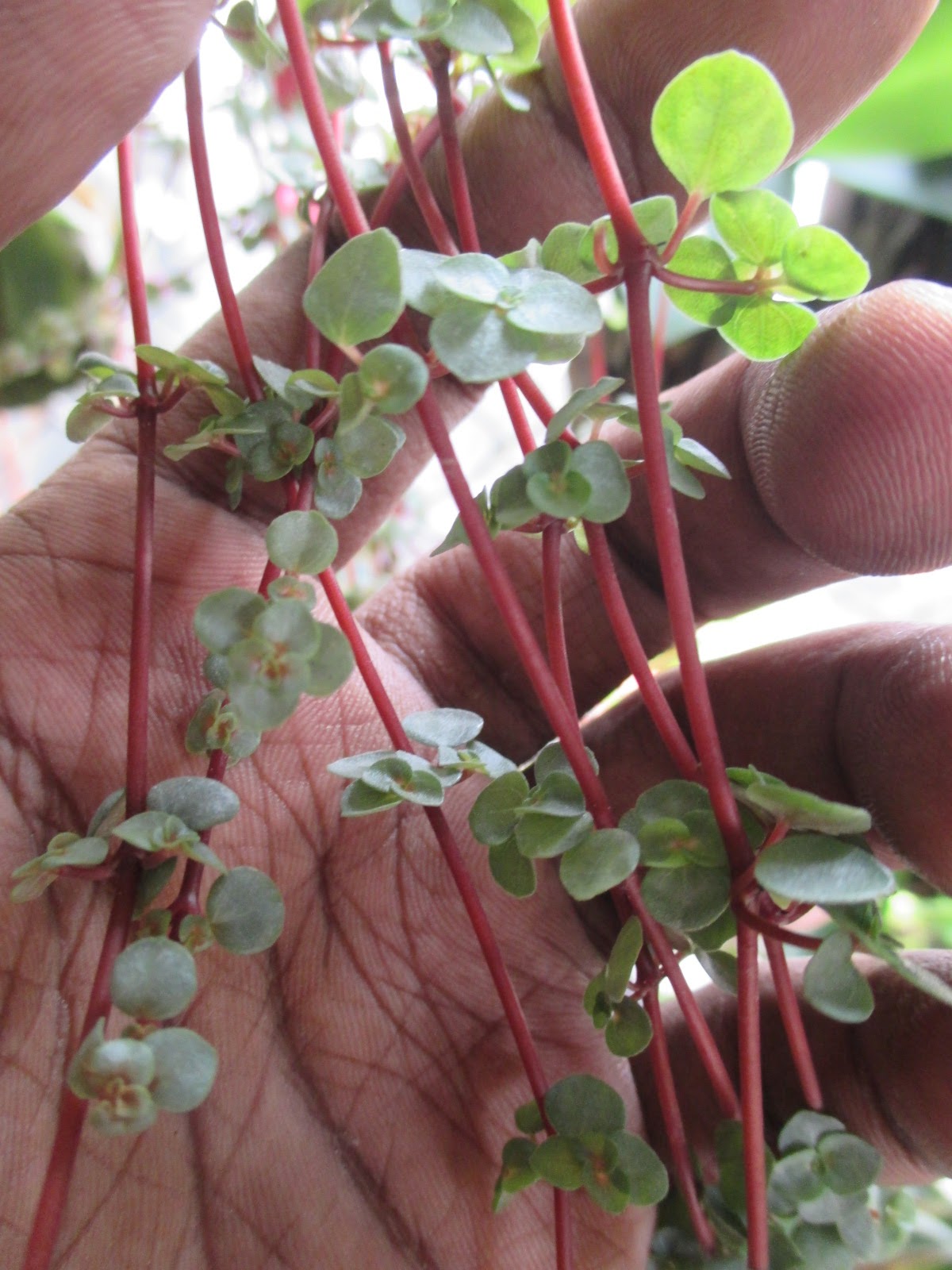
Pilea glauca – Silver Sparkles Plant


It is known as Silver Sparkles Plant or Grey Artillery Plant or Pilea glauca 'Aquamarine' and also Red Stem Tears.

It was said that it is P. libanensis but nursery owners use (Pilea glauca) as it's ID.


As strange as it is, Pilea glauca does exist but it is not this plant. 

The name was given out of error by a nursery owner for propagation and sale in some areas and the name got stuck with it.

Hence I think it's true name is P. libanensis.


Often I thought pilea are very much focused on the foliage but this one is very much on the vines - especially the red cascading vines.


Small minute blue green foliage appears in clusters on the red stem. It had a cascading trailing behavior but may easily suffer if not much space given for it have for growth space. 

It does well also as ground cover. 


Im intrigued by these lovely tiny insignificant furry flowers. Can you see them?


Light:
This one requires bright indirect light area - a right balance of not too hot nor too shaded.


Medium:

Do care to keep the plant in a small pot in a condense way as they love to grow in a tight closed condition.

This require a fast draining medium - something like a good mixture of perlite, sand & cocopeat.

It should not be a strong drainage mix where it doesn't hold any moisture at all but it should not be holding water too where the roots and stem can rot too. The balance of both is ideal.

Also the roots do not grow too deep a flat pot is more ideal and practical than a deep pot.


Watering:

I water daily and twice during the hot dry days. 

These can go without water for few days to a week and perhaps you have to take note on how the foliage appearance - if it appears withered or drying than watering is mandatory. 

The downside of watering will cost the leaves to turn yellow and start rotting - therefore - the right balance is necessary.
Position:

Do place it a position where it can cascade and trail downward. 

As there is a free space for it to tangle downward or else the whole vine may get messed with other plants and it can be messy.


Here is a mix of two types of pilea put together (silver sparkles) mixed with (baby tears) doing so well in their monochromatic green tones.


About Me

My photo
Tropical Garden, Batu Caves, Malaysia
My Malaysian Tropical Garden mainly focused on unique and colorful plants ranging from rare to common plants all around the tropical belt across the world. Ideal for inspiration for challenging areas in the garden space - indoor gardening, balcony gardening and small green spaces especially for ariods, bromeliads, begonias, edibles, cascading & vertical garden plants, succulents & cacti, orchids, together with both shade and sun loving plants.

Contact Me on the Form Above

Do put your queries on the contact form above and I will come back to you ASAP via e-mail. Also I'm open for any business / advertisement proposals / magazine articles / product sampling and sharing personal product experiences here in my blog. Also for specific plant queries where you need to send pictures for free consultation and plant help and aid.

Contact Form

Name

Email *

Message *

Blog Archive

Popular Posts

Popular Post - 1 Month