Search This Blog

My Vertical Garden Wall

My Vertical Garden Wall

TRASLATION LANGUAGE (CLICK HERE)

Showing posts with label Aranda Orchid. Show all posts

Tuesday, October 2, 2012

Orchids In My Garden

Orchid Species 1: 
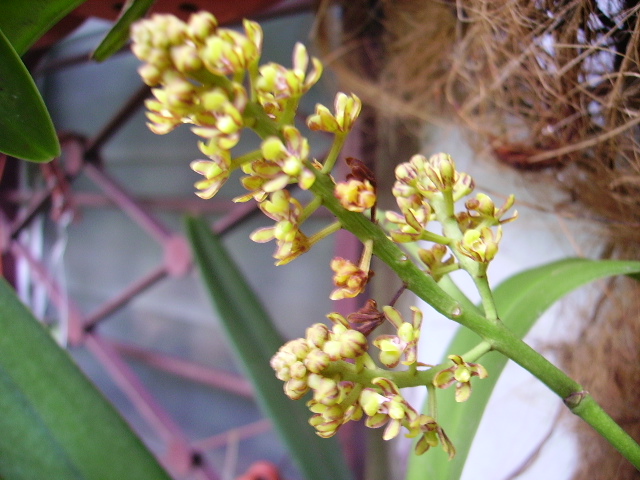
Name: Acampe sp.

I believe this is a native grows wildly on treetops. A friend of mine was kind enough to spare me a his extra. (Seemed like he had been passing me most of his collection) 
This specimen is from Raub, Pahang (Malaysia)

The plant is of a vanda species with a clustered  inflorescence. 
It took some time for me to appreciate its blooms & took awhile for it to bloom too.
(eventhough my friend had passed to me with the flower buds - it took almost a month for it to bloom)
 It doesn't seemed to have a white or a rosy lip - can't really define the exact specimen.


This picture is taken after a month from the earlier picture.
Notice 2 more clusters coming out from the main branch. 


Orchid Species 2: 
Name: Renanthera

This too is passed by another friend (office mate)
It is growing steady for sometime now. Earlier I had not fastened the coconut husk around the root base. Together with this - I manage to fastened other orchids along the PVC pipe.

From the top:
Orchid Species 3: Aranda
Orchid Species 4: Vanda
Orchid Species 5: Dendobium

I suppose that people prefer to have their orchids with blooms and when the flowers are spend they are somehow discarded. It must be the fact that some nursery practice heavy feeding in forcing the bloom in expense of the plant.
I even had noticed that flower spikes appear from dormant bulbs of dendobium orchids.
(Something that I jealously hope that it would also happen to my plants in my garden)

As in most cases where the orchid plant goes through high stress and finally gives out it's ultimate final bloom and when its done - it dies exhausted.
(This explains very much when you find citrus plant with loads & loads of fruits on it but eventually the plant succumb to slow death - especially sold during Chinese New Year)

The problem is too much fertiliser kills the plant. And I prefer to have the plant for a long term than to have it flowered and dies on a short-term basis.


Orchid Species 4: Vanda
This one has the Salmon Red flowers - it had bloomed twice in my garden.


Orchid Species 5: Dendobium

This had been rescued, and so I'm not really sure of its colour and flower.
A friend mentioned that you can guess the colour of the flower by the roots.
If the roots are white - most likely it would be in a whiter shade and the deep strong coloured ones might have red or maroon roots.


I had also placed a hoya plant together with the orchids to give some variety and shapes.


Orchid Species 6: Cymbidium Bicolor

I'm guessing as I had seen the flower spike from what my friend had shown me from his parent plant. This is a little plant from that source.
I have also the Cymbidium finlaysonianum which I'm hoping that it would bloom one day.


Orchid Species 7: Dendrobium sp.


Orchid Species 8: Eria sp.
I have not seen its bloom yet - so really have no idea how its actually looks.
It could be Coelogyne spp. - looks like I have to wait & see.


Orchid Species 9: Ionopsis

I have read few websites concerning this species. Native around the Caribbean islands.
It a short lived plant but nature has it that it tend to form mass colonies, bloom & set seed prolifically then die.  (Life span of less than 5-6 years)
In an environment such as mine - I doubt this orchid would create a mass colonies, let alone to see the bloom is quite a feat. Hope it flowers well before it matures and dies.


Orchid Species 10: Oncidium sp.

This suppose to have a different inflorescence compared to the common one.
It has a smaller flowers and a larger cluster.
Can't wait to see its bloom.


Orchid Species 11: Unknown.

I hope someone can give me some information on this.


Orchid Species 12: Oncidium Golden Showers

I had mount it on a branch and it is growing strong.


Orchid Species 13: Mokara

It had doubled it size now but sadly infected with scale insect.
I have been utilising the pest control on this plant but not very effective.

This is my overall Vertical Garden on Orchids.
Just hoping one day that all the flowers here would bloom and make a nice colourful setting at this side of the garden.


Friday, October 21, 2011

Orchid Blooms (Aranda Orchid)


It been ages (or never seemed) that my orchids bloomed. This is actually rescued - someone had thrown it away and I had collected it by the roadside. The condition of the plant was bad (dried up leaves, dead roots) and it required a lot of pruning of which even I was not sure of. Somehow, I was amazed when a flower spike shoot up. And these lasted almost a month for me to enjoy. The Bleeding Hearts eventually had taken over the other orchids which I tied along the fence. And this one constantly blooms with bouquets of flowers

Tuesday, November 10, 2009

Search & Rescue - Exiled Orchids


These are Aranda Orchids, they are hybrids.
Its a mix of Arachnis which have a slender, thinner petals and Vanda. (more rounded lapping petals) The result you get a fairly sized petals wider than the Scorpion Orchids.

I had purchased a peach coloured one (pic below) to try out.
It was one of my impulsive buying or rather I would say, I got an offer price when a vendor called me out and gave me a bargain.
I got it for RM5.00 - not bad for 2 stalks of flowers with a clay pot full of wood chips.
I would say that must be a cost price.
(Even a stalk of this orchid in a florist might easily cost about RM5.00)

These flowers lasted for 2 weeks in my garden, one gone in a week and the next follow suit after another week. All was OK, until I spotted something not quite right on the leaves.


.
These yellow spots and yellowing on the leaves are not dried matured leaves, something had gone wrong and so I have decided to uproot the whole thing from the pot.
.

.
After inspecting I had found out the culprit.
The roots where rotting inside the wood chips.
.
You will know by the texture of the roots, when it rots - it would be squishy, soggy like a sponge.
(trim off all the rotted parts as it would not continue to infect the good ones)
The good part of the root would be hard and firm. (Do not cut that part)
.
.
This is how a good salvage part look like (pic above)
.
.
Finally I have decided to place this one on the fence side - tied it on the post. It would have good air circulation to prevent root rot & hope I can get this one to bloom with my new fertiliser.
.
Something to note:
Vendors are vendors - they sell Presentation.
So you really need to know some characteristics of the plant before you buy.
.
Most Gardeners would not suspect the yellow on the leaves and would think that its natural for the leaves to turn yellow as it matures - but before you know it, the rotting would continue and will start to turn the whole stalk yellow.
When that happens, its just too late to safe anything.
.
I did go there again, (Orchid Garden) to check on the plant which had been sold there - whether did those turn yellow or thrive in that condition. I found out that the vendor had remove the plant from the pot & wood chips, trimmed off the flowers and sell the stalks (4 pcs for RM10.00)
So - Get the idea?
.
.
These are my rescued orchids.
.
The tallest one trailing all the way to the roof is Aranda. (the blue one - first pic) I got it from a Floralfest 4 years ago and wanted to try out my first orchid. It grew from the side of the fence and now all the way up. It still have not flowered and I guess I have not found the right fertiliser for it.
.
The second set of rescued plants are Reed Orchids. And I also found another 10 or so branches of Scorpion Orchids cut & thrown at the park near my house (where I also found Bleeding Heart Vine & Beehive Ginger plant)
.
They all look alike, only with the flowers one can tell the difference between each hybrids.
.


.
I also collected those short ones without the roots, I had tied it together with a wire and placed it at the inside portion of my fence. After a month or so, the stalk had started putting out new root shoots. So, I guess - this hybrid must be very resilient and hardy.
.
The most important thing about these type of orchid is the root system. If you can get a good setting for these roots to thrive then you have saved your orchid. The next stage is getting them to bloom.
.
.
How do you know whether the roots are healthy?
.
Inspect the roots, they must be white all the time, only when watered the turn to apple green.
The matured part of the roots are white but the tips are fresh green.
Never, ever - I repeat NEVER place these roots in a position where water is retained or collected on them permenantly. It would cause root rot.
Rather, place them in such a way that way runs down & washes on them.
(this is only applicable for the branch type of orchids)
.
Most or all of these orchids sold in pots where the roots are buried & pressed with wood chips.
So you really need to be very careful about it. It would be a wise thing to take out the whole plant & check the root condition. (All you know, the rotting stage had already begun when the orchids had been placed in store as sometimes its susceptible for lack of sunlight and over watering causing the medium to be damp & soggy)
.
Below are pictures of how a healthy thriving orchid roots should look like:
.


.
Very much earlier, these roots had found its way in my fern pots below and had very well adjusted to the soil and the humus.
.
I had placed a plastic bag & had trimmed it with many holes & placed the wood chips loosely on the hanging roots. If the roots grips these wood chips it would be a good chance where I could use an organic fertiliser where it would increase the chances of blooming these orchids.
.
Keeping my fingers crossed, I may need to remove and check this after a week or two, if the rot root occurs, I have to abandon the idea of placing them in any compost.
.
.
I gathered and found some very important information orchid care, been reading about them for years and trying to find out their jealously guarded secrets.
.
So here goes:
.
1) Find out what type of species of Orchid you have in your care, different types requires different needs. Not all orchids have the same cares & needs.
(eg: Ground Orchids requires soil bound whereas the branch type - Aranda, Arachnis, Vanda prefer exposed roots)
.
2) When gathering tips from the net - do find out where those orchids are planted. The Orchids planted in the tropical region have different tips compared to the orchids planted in the temperate climate region.
2a) Orchids grown in tropical region do not go thru climate extremes (winter or fall) and so when tips are mentioned about keeping orchids indoors - it might mean keeping them in greenhouse environment which is not applicable in tropical region.
.
3) Some orchids do so well in cold climate region which are considered very difficult to cultivate in tropical region and vice-verse. So, find out what species goes well in your area.
.
4) The Major 3-Fold rule: Light, Water & Feeding.
.
5) Light - Lacking light may cause slow or no growth - when there is no growth, no amount of fertiliser is going to help. Then there may be growth but may not bloom - this also got to do with receiving sufficient light. Here it can be identified by the colour & texture of the orchid leaves.
.
If the leaf colour is dark green - it means its not receiving enough light. It would be better to place it closer to the light source.
.
If the leaf colour is yellowish tinge with green & with burnt marks - it means that its receiving too much sunlight causing it to be sun scorched. Some matured leaves may give this colour so you need to check the young leaf shoot to identify this.
.
6) Water - too much water kills. If in doubt, do not water.
In most cases, orchid roots requires more air than any other medium placed on it.
These requires watering after the roots had dried out (Catteleya, Vanda & Reed Orchids) and there are those which the medium are in constant moist medium like the Moth Orchids & Slipper Orchids. So, its also depends on the species.
.
7) Feeding - if the lighting & watering is good, the next stage is getting the right fertiliser.
Organic ones are the best, if you accidentally over feed them with these - it won't kill your plant.
but too much will cause burnt leaf tips - that's the sign of too much fertiliser in the medium.
.
There is a rule: Weekly Weakly.
Again, I had became over zealous and sprayed a liquid fertiliser on these orchid plant continuously and had arrived with burned roots & leaf tips. I had stopped for few months until these plant recovered.
.
Well, my best advice, do some research, find out what other gardeners have been doing & getting them with successful blooms in your region. Tips are tips, for some strange reason, it works for your next neighbour but doesn't work out for you.
Sometimes its the art of tricking them to grow, thrive & bloom. You can do everything right & they don't bloom & when you abandon the "care" and they bless you with thousand flowers.
.
I guess that's why many of these are exiled after their blooms are done in my place. Many gardeners had got fed-up and had weed this one out, waiting for it to bloom unsuccessfully.

About Me

My photo
Tropical Garden, Batu Caves, Malaysia
My Malaysian Tropical Garden mainly focused on unique and colorful plants ranging from rare to common plants all around the tropical belt across the world. Ideal for inspiration for challenging areas in the garden space - indoor gardening, balcony gardening and small green spaces especially for ariods, bromeliads, begonias, edibles, cascading & vertical garden plants, succulents & cacti, orchids, together with both shade and sun loving plants.

Contact Me on the Form Above

Do put your queries on the contact form above and I will come back to you ASAP via e-mail. Also I'm open for any business / advertisement proposals / magazine articles / product sampling and sharing personal product experiences here in my blog. Also for specific plant queries where you need to send pictures for free consultation and plant help and aid.

Contact Form

Name

Email *

Message *

Blog Archive

Popular Posts

Popular Post - 1 Month