Welcome to my Tropical Garden in Malaysia where the focus is mainly cultivating unique and colorful plants ranging from rare to common plants all around the tropical belt across the world.
Search This Blog
My Vertical Garden Wall
TRASLATION LANGUAGE (CLICK HERE)
Showing posts with label Amaryllis. Show all posts
Friday, November 29, 2013
Amaryllis At its Peak.
It is indeed a joy to see all of them bursting with flowers.
These Amaryllis seemed to be very happy and when the start flowering somehow they just do it in a herd.
I had kept aside few of these bulbs aside after its blooming season and now they are at their peak.
Some of the spikes have 5 flowers in that stalk. (normally its 4)
And some bulbs are shooting 2 flower spikes. (normally one in each bulb)
It is indeed a heavy load of flowering going on in my garden.
Monday, November 18, 2013
Amaryllis Season
I had left these bulbs to grow their leaves and settle for few months before trimming them off and storing them in a cool place. I think it would have been like 3-5 months period time when suddenly few of these bulbs are shooting flower spikes. I manage to put them close together as the flowers starts to bloom.
It is indeed lovely to enjoy these blooms nearing the holiday season.
Tuesday, April 23, 2013
Garden Overview - March 2013
There is a lot to talk about this season in my garden, especially when the garden is
constantly evolving by itself without the help of the gardener.
Nevertheless, the beauty of how these plants adapts itself without much maintenance and care itself amazes me.
This season is totally foliage and sprays of flowers.
Hope you enjoy seeing what March had offered me in my Garden.

This season is totally foliage and sprays of flowers.
Hope you enjoy seeing what March had offered me in my Garden.
Monday, August 2, 2010
Amaryllis Bloom
I was thinking about the name "Amaryllis" and
it was playing in my mind for sometime.
whether:
"I'll marry Liz" or
"A Mary List" or
perhaps... " A Merry Least"
maybe the last one - when they never seemed to bloom in the tropicals.
I remembered about an experience about putting all these bulbs in the fridge in the vegetable compartment. My sister thought it was a vegetable when she came by and waited to help in preparing lunch.
So this is a WARNING:
AMARYLLIS BULBS ARE POISONOUS!
DO NOT MISTAKEN THEM FOR A VEGETABLE AND COOK IT!!!!
(That is if someone would have thought - Hey! That's a pretty exotic looking onion!!!)
My wife sort of grumbled for 3 months for taking half of the vegetable compartment space.
So, its another thing you may have to "negotiate" if you are a guy.
(Probably show her these pictures and the last one on how to prepare it - It might soften her heart in agreeing in "leasing" the fridge space for you.. perhaps?)
I guess a woman gardener who prepares meals and "owns & manages" the fridge do not face this problem. All she have to do is mark on the package:
WARNING! DO NOT TOUCH THIS!!!
Anyway, these are the beautiful pictures I took last weekend - hope you enjoy them.
I'm totally mesmerised by the blooms and two more waiting.
Though, I'm a little excited as I guess the other two spikes are the same type like the first one.
Another thing, do not bloom them during the raining season - the flowers tend to get overweight and with the constant showering the whole flower and spike gets too heavy and well...
"Fall on the ground". I had to put a stick and tied it for a support.
So keep it in mind, the best time would be the hot season.
It would also keep the bulbs from rotting (wouldn't want to take that chances)
Friday, July 30, 2010
Blooming Amaryllis in the Tropical.
Do you have a pot of Amaryllis plant that never seemed to flower for years?
Have you seen any sitting by the corner of your garden, forgotten for ages and you really can't remember how the flower looked like?
Wondered how the bloomed ever looked like when somehow hands over the bulb giving up on them, and taking them thinking that one day - just one day - luck will be at your side and you might just perhaps enjoy the bloom one day?
Well, this is my side of the story with the Amaryllis flower.
I have been keeping them for years and never once saw any bloomed. All the more some of my gardener friends passed me their bulbs giving up hope in seeing their blooms too.
The closest bulb blooms that I ever got to enjoy are those rainlilies but that's it.
And so, the experiment goes - I had tried few different methods:
The first was the trimming off all the leaves just above the crown.
This worked exclusively for the Rainlilies but was not successful for the rest of the other types.
Then the 2nd experiment was giving them a heavy dose of organic fertilisers.
Still nothing happened except for their beautiful boring leaves, apparently there were little bulbs sprouting from the main bulb.
(I want flowers not offsprings!!!)
And so I went with the 3rd. uprooting all of them, turning over the soil and replanting them - removing all the little offspring and adding more soil and fertiliser. I thought just probably when they go through the process of uproot and replanting - the shock might just cause them to bloom.
Few months passed and nothing happen.
By luck, I chanced to come across a gardener who put in details about forcing the Amaryllis bulb.
Imagine the joy that I had in getting them to bloom!
I must thank Ha Xuan from Veitnam (Tuysonvien - Where I Garden)
for the force blooming details.
You can click the link (name above) for more details for this information.
If you have a pot of Amaryllis bulb in the tropical region and they never seemed to flower for ages, you can force bloom them with this simple process:
1) Before selecting the bulbs for the processing, inspect that they have at least 6 healthy leaves and must not have bloomed for the last 10 months.
2) The whole process may take around 4 months, if you would like to have these blooms appear during a festive season like Christmas or Weddings - you can start prepare them 4 months ahead to get these blooms appear.
3) Dig out the bulb from the soil or pot. Make sure you don't damage the roots in the process. (note: its better to plant it in a pot as when required all you have to do is overturn the pot and knock out the soil carefully, this way - you can shake off the soil with minimum or no damage to the bulb and roots)
4) Cut off all the foliage leaving a "neck" of about 3cm above the bulb.
(Again alternatively, you may also choose to leave the whole plant from the soil and let the foliage to dry up naturally - that way all the nutrients will be stored back to the bulb but this may take another few weeks and sometimes months for them to dry up)
5) Wash off all the dirt from the bulb and hang it upside down, in the shade to dry for 1 week.
(picture below)
.
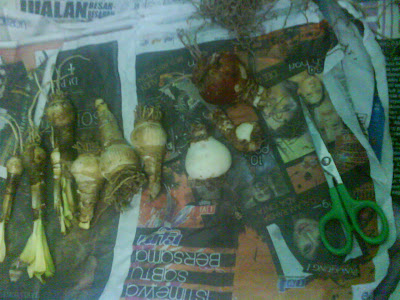
The ones above are Blood Lily - not successful with this process
(well, I have to try it and see if it works right?)
.
.
6) After 1 week, wrap all the bulb in newspaper and place it in the vegetable compartment of the refrigerator for 8 weeks. Remember to mark the newspaper with the date you wrap the bulb so you remember. Also, don't store any fruit in the fridge during this time lest the bulb can be damaged by the gas from the ripening fruit.
.
Do check the bulbs time to time, (like once a week) sometimes the newspaper may turn soggy and may rot the bulb. You may have to transfer them to a new set of wrapping. I had done this couple of times. (And please make sure you wrap with with several pieces of paper - one big piece won't do)
.
.
7) Finally take out the bulbs after 8 weeks, cut off all the dried roots but leave out the fresh ones.
(I had placed them for 3 months due to lack of time to tend on them)
You may have to start collecting all the little bottles to hold the bulb (during the 8 week period)
.
8) Place the bulb just rightly above the rim of the bottle but not let the water to soak on the base of the bulb. you may need to be cautious on this as totally submerging the bulb in water may cause bulb rot and all your effort is lost. So, do check on the level of the water after an hour later as strangely as it might appear to be - the level change time to time.
.
.
9) You can leave the roots on water from 1 - 3 days. Better keep it in a day at most.
These are in water for 3 days. (this was my problem with time management)
.
10) Once this is done - plant them in the pots, you need to prepare the soil first before planting.
Make sure that the soil is moist but not wet & soggy. Plant the bulb 1/3 buried on the soil but 2/3 exposed. Do not water for another 2-3 days but lightly keep the soil moist and place the pot in a shaded area.
.
11) Start watering (again sparingly) when you see new sprouts of leaflet appearing from the centre of the bulb. Also you will notice that the bulb may just shoot out the flowerscape from the side of the bulb. (you can notice it in the pic. below)
.
12) Once this progress takes place, transfer the pot from the shady area to a brighter location.
This process may take within another month.
.
.
These are my bloodlily bulbs - they didn't bloom in this process.
Well, it was another trial experiment.
.
.
These are too young and small bulbs (plantlets and off shoots from the main bulbs)
I had kept them here until they grow bigger for the process.
(notice most of them have only one leaf or two - these are not successful for force blooming)
.
.
Notice the flowerscape without their leaves?
I'm so excited everyday in seeing their progress.
.
.
Can you see the leafscape in the centre and the flowerscape coming out from the sides?
.
.
These pictures taken after few weeks, 3 flowerscapes appeared from the whole process, others are still dormant.
.
.
Finally this one bloomed yesterday. I took these picture using the handphone camera, by the time I reach home - I was getting dark.
.
Finally after all these years - I got the chance to enjoy the bloom. Never dream this was possible.
I guess this "force blooming" is necessary for those who are having it in the tropical climate for they do not go through the natural process of the four season here.
.
I got another 2 more flowerscape to bloom and not very sure how they are going to look like.
(Just to inform you - I have collected a lot of these bulb from many friends who had given up on them, I'm hoping that all of these bulb are different from each other)
.
Subscribe to:
Posts (Atom)
About Me
- James David
- Tropical Garden, Batu Caves, Malaysia
- My Malaysian Tropical Garden mainly focused on unique and colorful plants ranging from rare to common plants all around the tropical belt across the world. Ideal for inspiration for challenging areas in the garden space - indoor gardening, balcony gardening and small green spaces especially for ariods, bromeliads, begonias, edibles, cascading & vertical garden plants, succulents & cacti, orchids, together with both shade and sun loving plants.
Contact Me on the Form Above
Do put your queries on the contact form above and I will come back to you ASAP via e-mail.
Also I'm open for any business / advertisement proposals / magazine articles / product sampling and sharing personal product experiences here in my blog.
Also for specific plant queries where you need to send pictures for free consultation and plant help and aid.
Contact Form
Blog Archive
Favorite Popular Posts (Please click on links below)
- ANTHURIUM - Different Types with Names & Images
- JEWEL ALOCASIA - Different Types with Names & Images
- ALOCASIA - Different Types with Names & Images
- COLOCASIA (TARO) - Different Types with Names & Images
- BEGONIA - Different Types with Names & Images
- CANE BEGONIA - Different Types & Images
- DIEFFENBACHIA (DUMBCANE) - Different Types with Names & Images
- EPISCIA - Different Types & Images
- FERNS & ALLIES - Different Types (Names & Images)
- HUPERZIA (Tassel Ferns) Different Types - Name & Images
- DISCHIDIA - Different Types with Names & Images
- HOYA - Different Types with Names & Images
- CALLISIA - Different Types & Images
- TRADESCANTIA - Different Types with Names & Images
- INDOOR PLANTS - Different Types & Images
- FRAGRANT FLOWERS - Different Types of Tropical Fragrant Flowering Plants
- KVPA Plant Acquisition #PAE Events List
Popular Posts
-
My Garden is slowly settling to its permanent position where I'm going to maintain what I have currently. The best idea in keepi...
-
I had wanted to list all the begonias and their ID with images here. Somehow it will be overwhelming to put the whole genes here which ...
-
CANE BEGONIA UPDATE : 9th July 2024 I have found after years of experience that there are difference between Cane Begonia species where ther...
-
Most of my friends asked me about where I purchase my plants. I often tell them about this very famous nurseries, the ones located in Sg....
-
INTRODUCTION: To have or not to have. What if all the neighbors around your surrounding area plants this same plant, Would you consider ...
-
I would like to introduce a New Series on Indoor Plants and hope to come up with 10 Best Indoor Plants for Beginners. I'm guessing...
-
INTRODUCTION: Jasminum sambac commonly known as Grand Duke of Tuscany Jasmine especially this particular variety where it is famously know...
-
I had wanted to list all the Episcia and their ID with images here. Somehow it will be overwhelming to put the whole genes here which will ...
-
It was one of my zealous moments where I have decided to just go and see whats happening in this Orchid Garden. Its situated inside KL Lak...
-
I have come across many gardeners who had stopped gardening for the fear of mosquito's. Though it sound like a laughing matter but not s...
Popular Post - 1 Month
-
CANE BEGONIA UPDATE : 9th July 2024 I have found after years of experience that there are difference between Cane Begonia species where ther...
-
I had wanted to list all the begonias and their ID with images here. Somehow it will be overwhelming to put the whole genes here which ...
-
Different Types of Colocasia (Taro) / Elephant Ears Plants INTRODUCTION: The very fact to note that there are a huge cultivars and hybrids o...
-
My Garden is slowly settling to its permanent position where I'm going to maintain what I have currently. The best idea in keepi...
-
INTRODUCTION: Jasminum sambac commonly known as Grand Duke of Tuscany Jasmine especially this particular variety where it is famously know...
-
I had wanted to list all the Episcia and their ID with images here. Somehow it will be overwhelming to put the whole genes here which will ...
-
It feels like ages when I actually started this plant from seed to this point when I can finally enjoy the flower. I never imagine the mom...
-
What a Long Break : June 2023 - July 2024 From Blogging I'm so surprised that time just few just like that. A lot had happened during th...
-
INTRODUCTION: Wrightia Religiosa commonly known as Water Jasmine, also known as Sacred Buddhist, Wild Water Plum & Wondrous Wrightia...
-
Here are the list of the plants - specifically these Alocasia type which is commonly known as Jewel Alocasia which is quite sensitive and hi...

